
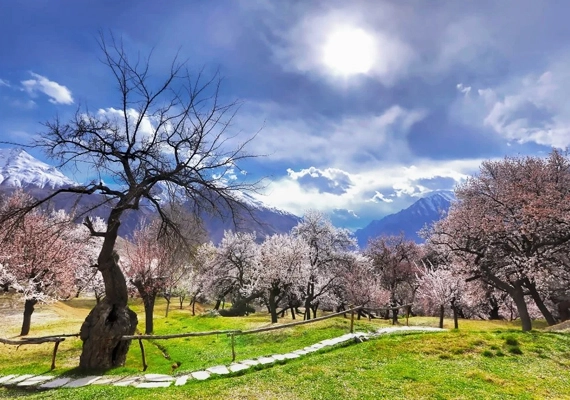
When the Karakoram winter finally breaks, Hunza Valley turns pink and white almost overnight. Thousands of cherry, apricot, and almond trees burst into bloom at the same time, while the same enormous, snow-capped Karakoram peaks tower behind them, completely unbothered. The contrast is almost surreal brown mountain slopes, white glaciers, pink orchards, all in the same frame.
If you’ve been thinking about Hunza and wondering whether spring is worth it? Yes it is. It’s not as crowded as summer, hotels cost less, and for sheer visual drama, cherry blossom season delivers something that mid-July simply cannot.
1. When Does Cherry Blossom Season Start in Hunza?
The honest answer: mid-March to mid-April — but where exactly in the valley matters a lot. Hunza stretches across dramatically different altitudes, and the bloom follows those altitudes like a slow wave moving northward.
| Zone | Villages | Bloom Dates | Notes |
| Lower Hunza | Aliabad & Karimabad | March 15 – 25 | Blooms first. Trees sit at ~2,400m and warm faster. |
| Central Hunza | Altit, Ganish & surrounds | March 25 – April 10 | Peak bloom for most visitors. Sweet spot for photography. |
| Upper Hunza | Gulmit, Passu & Gojal | Late April | Later and cooler, but extraordinarily dramatic — Passu Cones backdrop. |
| 💡 PRACTICAL TIP If you arrive around March 25–28 and spend a week driving northward, you can follow the bloom as it moves up the valley. Start in Karimabad, move through Altit and Ganish, and finish in Upper Hunza. One trip, multiple bloom windows. |
2. What’s Actually Blooming? (It’s Not Just Cherry)
People call it “cherry blossom season” — and that name has stuck — but what you’re actually looking at in Hunza during spring is a layered sequence of five different trees all putting on a show within a few weeks of each other.
| Tree | Flower Color | Bloom Timing |
| 🌸 Almond | White, delicate | Late Feb – early March |
| 🌸 Cherry | White, abundant | Mid to late March |
| 🌸 Apricot | Pink, everywhere | Late March – early April |
| 🌸 Apple | White-pink | Early to mid April |
| 🌸 Pear | Bright white | Mid April |
The apricot trees deserve special mention. Hunza is genuinely famous for its apricots they’re a major part of the valley’s economy and identity and the terraced hillsides around Karimabad and Altit are covered in them. In late March, when they’re all in full bloom at once with Rakaposhi rising behind them, it’s the image that’s been putting Hunza on international photography maps for the last decade.
| “The combination of pink apricot blossoms, brown mountain slopes, and snow-white Karakoram peaks in a single frame is something photographers travel thousands of miles to capture.” |
3. Best Places to See the Blossom in Hunza
1. Duikar — Eagles Nest Viewpoint
Thirty minutes above Karimabad, this ridge-top viewpoint gives you the whole valley in a single frame — the entire floor covered in pink and white, the Karakoram peaks rising behind it. Sunrise here in late March is one of the best experiences available anywhere in Pakistan.
🌅 Go for sunrise — 6:30–8am in late March
2. Baltit Fort — The Classic View
The 700-year-old fort sits high above Karimabad, and the walk up to it in blossom season is something you won’t forget. Flowering apricot trees line the path the whole way, with Rakaposhi and Ultar Sar visible in the background. Go on a weekday morning if crowds bother you.
📸 Best light: 7–10am, before the valley haze builds
3. Altit Fort & Royal Garden
Slightly less visited than Baltit but in many ways more beautiful during spring. The garden at Altit’s base fills with flowering fruit trees in March. Sit here with a cup of Hunza tea and watch the mountains — it’s the kind of afternoon that makes you extend your trip.
⏱ Less crowded than Baltit, especially on weekdays
4. Karimabad Bazaar & the Old Village Lanes
Walk through on a quiet morning and you’re surrounded by apricot trees down every alley, locals going about their routines, farmers setting up the day’s produce. Not just a viewpoint — it’s life in a blooming valley, and worth two or three slow hours.
☀️ Morning walk before 9am is most peaceful
5. Upper Hunza — Gulmit, Ghulkin & Passu
These villages are quieter, bloom is later (late April), and the setting is more dramatic than anywhere in central Hunza. The Passu Cones — those impossibly jagged peaks — rise directly above the orchards. If you can extend your trip into late April, this stretch is worth it.
🏔 Passu Cones backdrop is unmatched anywhere in Pakistan
4. Practical Things to Know Before You Go
Book your hotel in January – seriously
Cherry blossom tourism in Hunza has grown dramatically since 2022. Good hotels in Karimabad, especially those with mountain views, fill up months in advance for the late March to early April window. If you’re reading this in February and still haven’t booked, check availability today, not next week.
The weather is unpredictable – pack accordingly
Spring in Hunza can be warm one afternoon and cold and rainy the next morning. Pack layers: a warm fleece, a rain jacket, and comfortable walking shoes that handle wet paths. Mornings and evenings can be genuinely cold even when midday is pleasant.
The blossom lasts 2–3 weeks at each location
There’s no single perfect day to arrive. If you’re coming anywhere between March 20 and April 15, you will see blossom somewhere in the valley. The altitude breakdown in Section 1 helps you plan which part to prioritize.
| 📷 PHOTOGRAPHY TIP Morning light — especially between 7–10am — is when Hunza looks its most extraordinary. Mist still sits in the valley, the peaks catch the early sun at an angle, and the air is clearer than it will be all day. Afternoons tend to get hazy. Plan your key viewpoints for mornings. |
Roads are usually open, but verify before departure
The Karakoram Highway is generally open by mid-March, but occasional landslides can cause short delays. If flying Islamabad–Gilgit and driving from Gilgit (~2.5 hours), this is the most reliable spring option. Check current conditions with your hotel or tour operator a few days before you leave.
5. Spring vs Summer – Which Is Actually Better?
This is the most common question we get. Here’s an honest answer rather than a sales pitch.
| What You Want | 🌸 Spring | ☀️ Summer |
| Cherry & apricot blossom | ✓ Yes | ✗ No |
| Fewer crowds | ✓ Yes | ✗ Busier |
| Lower hotel prices | ✓ Yes | ✗ Peak rates |
| Khunjerab Pass open | ✗ Closed | ✓ June onward |
| High-altitude treks | ⚠ Limited | ✓ Full access |
| Karimabad sightseeing | ✓ Excellent | ✓ Excellent |
| Valley road access | ✓ Good (verify) | ✓ Fully open |
The bottom line: if your priority is the famous views — the pink orchards against white peaks — come in spring. If Khunjerab Pass or high-altitude trekking is the main goal, come in summer (June–August). For most first-time visitors, spring delivers something summer, for all its advantages, simply doesn’t have.
6. How to Get to Hunza for Blossom Season
| ✈️ Fly: Islamabad → Gilgit 45-minute PIA flight, then 2.5-hour drive to Karimabad. Fastest option. Book flights alongside your hotel — both fill up in March. ★ RECOMMENDED | 🚗 Drive: via KKH 14–18 hours Islamabad to Hunza. Most people split over two days, staying in Chilas or Besham. Nanga Parbat is visible near Chilas — the drive itself is spectacular. |
Note: The Babusar Pass route through Naran is only open June–September. Not an option for spring visitors.
7. What to Do in Hunza Beyond the Orchards
Baltit Fort and Altit Fort : Both take 1–2 hours and are genuinely fascinating. Baltit in particular has been well-restored and tells 700 years of Hunza history. In spring they’re quieter than summer, which makes them better.
The water channel walks : The hand-carved irrigation channels running along the hillsides above Karimabad are one of Hunza’s quiet wonders. Walking these with the orchards below you and the peaks above is something most visitors miss entirely.
Karimabad bazaar : Try Hunza bread, walnut cake, and fresh apricot juice. Buy dried apricots and locally-made jewellery. Budget at least a morning here without any agenda.
Walk through old Baltit village: From Karimabad up through the ancient village to the fort takes 2–3 hours at an easy pace. No guide needed, just follow the path upward through the most beautiful orchard country in the valley.
Duikar for sunset or sunrise : Do this at least once. Thirty minutes by jeep from Karimabad. Worth every moment.
8. Frequently Asked Questions
When exactly is peak cherry blossom in Hunza 2026?
Peak bloom for central Hunza (Karimabad and surrounds) is typically March 25 to April 10. Lower Hunza blooms slightly earlier (March 15–25) and Upper Hunza blooms later (late April). These dates can shift by 3–5 days depending on that year’s weather patterns.
Is it cold in Hunza during cherry blossom season?
Yes, mornings and evenings can be genuinely cold — temperatures can drop to 2–5°C at night in March. Daytime in late March is usually 12–18°C and pleasant for walking. Pack layers including a warm fleece and a waterproof jacket.
How long should I spend in Hunza during spring?
Minimum 4 nights to see the key spots without rushing. 7 nights is ideal — it lets you day trip to Altit and Upper Hunza, catch different weather windows for photography, and actually relax into the valley.
Can foreigners visit Hunza during cherry blossom season?
Yes, Hunza Valley is open to international visitors. Foreign nationals need a valid Pakistan visa (available online for most nationalities). An NOC is no longer required for Karimabad and central Hunza. Your tour operator will advise on any updated requirements for 2026.
Is Hunza safe for solo female travelers in spring?
Hunza is consistently cited as one of the safest destinations in Pakistan for solo female travelers — local and international. The valley has a long tradition of welcoming visitors, and Karimabad is well set up for independent travel.
| Ready to See Hunza in Blossom? We run guided Cherry Blossom Tours every March and April — transport, hotels, and local guidance all sorted. Limited spots available for peak dates. pakistantourmaker.com/tours/cherry-blossom-hunza/ |